|
The
Marchio family being in business in Joliet began with
Ceasar Jake Marchio. Jake, as he was known to family
and friends, began his work ethic early in life. Jake
was born in Joliet on December 17, 1910. At nine or
ten years of age he began helping the milkman deliver
his goods. This was before school each morning. The
milkman would drop him off in time for school. He was
paid thirty-five cents per day. His second job was as
a paperboy for the Joliet Herald-News. After a year
and one half or so, he started his third job. This job
was at Allen's Battery Shop. He worked there every day
after school until 9:00 p.m., as well as a full day
on Saturday and a half say on Sunday. He would do maintenance
on batteries and recharge them for the customers. He
was paid $3.50 per week for his work. While attending
continuation school around the age of sixteen he worked
at the Joliet Wallpaper Mill. He worked there for approximately
three years, earning $15.00 per week. He then started
to work fulltime for fifty cents per hour at the deep
water way (part of the canal system in Joliet) for one
summer. During that summer he started getting an urge
to go into business for himself.
|
|
|
US
CHAMBER OF COMMERCE CERTIFICATE
|
By
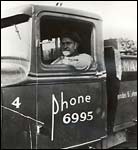
the fall of 1930, he had bought an old Model "T" truck
for $15.00. This was the beginning of his coal delivery
business. He started trucking coal independently for
$1.00 per ton, delivered. It was dirty work but he enjoyed
himself. On a good day he would make as much as $12.00.
He placed ads in the Herald-News and kept himself busy
during the slower seasons by unloading coal cars for
the Midwest Coal Co. The work was all done by hand.
One day, while preparing to unload a car, Jake, with
his brother Sam, happened to notice that the railroad
tracks they were unloading the car on, continued across
the way from the Midwest Coal Company to a vacant lot
where the tracks terminated. He thought to himself that
that would be a good spot for his own coal yard, since
having access to a rail line was key in that business
and the expense of having tracks laid was out of the
question. He had no idea how soon his observation would
pay off.
A
couple of months later Pat Timson, the owner of Midwest
Coal Company, was in financial trouble. Mr. Timson tried
to collect money due him from bad accounts to pay his
bills. Mr. Timson was eventually forced out of business.
He was leasing the property on which his office building,
ice house, and scale were located. When Mr. Timson's
equipment went up for auction, Jake realized his big
opportunity. So Jake, with his older brother Sam, attended
the auction. Jake only had $125.00 to his name and it
was in his front pocket. Once the auction started Jake
seemed to forget how much money he had and ended up
bidding $250.00. Jake, being embarrassed for making
such a bid, started to walk away. Then the auctioneer
hollered, "Just a minute young man, you've got it!".
Well, lucky for Jake his brother Sam was with him. Sam
told Jake he had about the same amount of money at home,
enough to cover the balance. At that moment, Jake asked
Sam to go in half with him. Sam agreed. This was the
beginning of Marchio Coal Company and their partnership.
There
were plenty of obstacles ahead, one of the biggest concerned
relocation their newly purchased equipment. The office
building, ice house and scale, which were all on private
property, needed to be moved within thirty days of their
initial purchase. Jake and Sam had originally hoped
to have more time or possibly lease the property the
equipment was already on. Being tapped out of money,
they could not afford land of their own. Facing this
dilemma, Jake thought of the vacant lot by the rail
line nearby and asked to lease it for $48.00 per year.
After signing the lease, Jake and Sam started to clear
the area of brush and trees. They also had to level
off the surface of the lot for the building and fence.
They worked very hard that summer. Now it was time to
buy their first car of coal. After asking an aunt for
a loan, they purchased their first load of coal from
Peabody's Mine in Westerville, Illinois. It was October
16, 1934. The very same year Marchio Coal Company handled
thirty-five cars of coal. Every cent earned was put
directly back into the business. At this point the loading
of delivery trucks and the unloading of rail cars were
done strictly by shovel and back. It was not until several
years later that this task became automated.
Later
in 1936 they added coal stokers to their business. They
installed and serviced these stokers in people's homes.
Business was going well. They finally bought their first
new truck in 1937. In 1939 they bought nine acres of
land facing Linden Avenue, adjacent to their present
location near the corner of Rowel Avenue. Once again
they cleared the lot and hauled fill in to level the
land in preparation for a new masonry building. When
they finally completed this work in 1942, Jake and his
brother were very proud of what they had accomplished
with their hard work.
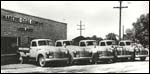
In
1949 Marchio Coal Company bought another new truck and
hired five drivers to deliver coal. They were handling
175 to 200 cars of coal a year. In the next year they
replaced their old trucks with four new trucks and some
new equipment, such as unloaders and conveyors. Jake's
and Sam's peak business year was around 1955. They handled
225 cars of coal that year. Although times were good,
they knew that time was going to change that. As gas
and oil heating gradually replaced coal burning, Jake
and Sam began to shift their business into handling
plywood. To compensate for the declining sales in coal,
the brothers added paneling, trim, ceiling tile and
floor tile to their business. They stayed at the same
location on Linden until 1965. The company moved to
907 Rowell Avenue, just one half mile away. Interstate
80 was scheduled through their property on Linden and
staying was not an option. They, of course, knew about
this move in plenty of time. They had put up buildings
and an office by 1965 at the Rowell address. The name
was then changed to Marchio Plywood Company. Both locations
were in use for a short time. Jake's two sons, Phil
and Mike, and Sam's son, Sam Jr., were already working
for the company for some time.
 |
|
GROUP
PHOTO
|
Mike,
who is Jake's youngest of five children, started working
construction in 1963. By 1967 Mike had learned to install
many different types of fence. Near the end of the year
Mike had asked his older brother Phil, who was still
working for Marchio Plywood Company, if he would go
into the fence business with him. Phil agreed. They
started Marchio Fence Company and worked out of Mike's
house. At this time Mike was installing fence full time,
while Phil worked the books and did estimates after
working for his father at Marchio Plywood. By the mid
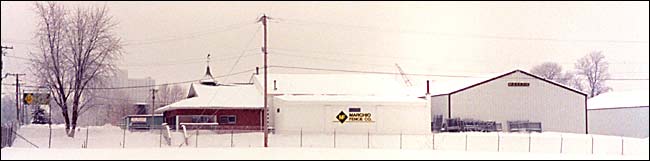
1970's Marchio Fence Company moved to an industrial
park on Alesslo Drive in Joliet.
Sam
Marchio wanted to retire, so he sold his half of Marchio
Plywood to Jake in 1974. Eventually, after years of
growth, Marchio Fence Company moved to its present location
at 907 Rowell Avenue and rented space from Jake. In
1989 Jake retired from Marchio Plywood. Mike and Phil
took over the plywood business, which Phil had been
managing for some time. Jake passed away on December
27, 1998, at 88 years of age. He is greatly missed by
all. Phil retired the following year. He sold his half
of Marchio Fence Company to Mike.
Today
the paneling business has been phased out, although
Mike does carry plywood for some select customers.
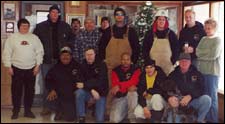
Mike
Marchio works with his two sons, Michael and Matthew,
as well as his wife, Cathy. Also working for Mike is
his brother-in-law, Gabby, who has worked for Marchio
Fence for many years. In the office there is Mary Kuhajda,
who has been with the company for over twenty years,
Mark Peterson and Bette Jo Altiery, Cathy's sister.
There are many others who have worked at Marchio Fence
for many years and hopefully for many more to come.
|